Descartes’ 10th Annual Study Finds Transportation Technology Investment Has Increased Nearly 50% Over the Past Decade
Fewer than one in five organizations are using AI at scale as data quality, integration complexity and automation gaps
Press Release Disclaimer: This is a press release distributed through the XPR Media network. It has not been independently verified by our newsroom.

Fewer than one in five organizations are using AI at scale as data quality, integration complexity and automation gaps challenge transportation transformation
ATLANTA, Sept. 16, 2026 (GLOBE NEWSWIRE) — Descartes Systems Group (Nasdaq:DSGX) (TSX:DSG), the global leader in uniting logistics-intensive businesses in commerce, announced the results of its 10th Annual Global Transportation Management Benchmark Survey. The study shows how transportation management has evolved over the past decade from an operational function into a strategic driver of business growth, customer experience and competitive differentiation. It also reveals that the next phase of transformation will depend on organizations’ ability to scale automation and artificial intelligence (AI).
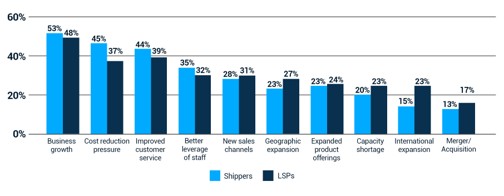
Over the 10 years of the study, the percentage of surveyed North American organizations planning to increase transportation management (TM) technology investment has risen from 53% in 2017 to 78% in 2026. At the same time, 85% of organizations now view transportation as either a competitive weapon or customer service differentiator, compared with 65% in 2017. Business growth is also the leading driver of transportation management system (TMS) adoption for both shippers (53%) and logistics service providers (LSPs) (48%), maintaining its top position for the second year in a row (see Figure 1).
Figure 1. Business Drivers for TMS Adoption
Source: Descartes/SAPIO Research
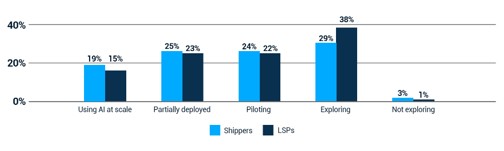
Despite transportation’s growing strategic role and sustained technology investment, the study identifies significant opportunities to advance operational maturity. In addition, only 19% of shippers and 15% of LSPs report using AI at scale, with most organizations still exploring, piloting or partially deploying it (see Figure 2). Data quality is the leading barrier to scaling AI, cited by 45% of LSPs and 33% of shippers, followed closely by integration complexity at 38% and 39%, respectively. The findings suggest the next stage of transportation AI adoption will depend increasingly on the digital infrastructure that enables AI to operate effectively across transportation networks.
Figure 2. Level of AI Adoption
Source: Descartes/SAPIO Research
Other key findings include:
- Growth expectations remain resilient: 79% of shippers expect at least 5% annual growth over the next two years, while 84% of LSPs expect the same. Nearly three-quarters (74%) of LSPs expect annual growth of 5–15%, up 26 percentage points year over year.
- Cost pressures remain significant: Freight cost management is the largest current transportation challenge for shippers (35%) and LSPs (25%). Rising industry costs are also the top external factor expected to impact transportation management over the next five years.
- AI is producing tangible operational benefits: Shippers report the greatest realized AI benefit in reduced administrative and labor costs (55%), while LSPs cite improved service (53%) and freight cost reduction (46%).
- Truckload visibility needs improvement: Full truckload is the mode most frequently identified as needing better real-time visibility, cited by 57% of shippers and 43% of LSPs—up 14 and 19 percentage points, respectively, from 2025.
- AI and cost control create a dual mandate: Increasing AI adoption is the top transportation priority for shippers and LSPs combined (58%) over the next two years, with reducing freight costs a close second (57%).
“Ten years of benchmark research shows that the transportation technology conversation has fundamentally changed,” said Alan Dunkerley, SVP, Product Management at Descartes. “Organizations no longer need to be convinced that transportation technology creates value, as they are increasingly focused on how to maximize that value. In addition, with AI now a strategic priority, the ability to connect transportation networks, automate processes and create high-quality, real-time data will be critical to moving AI from experimentation into scaled transportation operations.”
Descartes and SAPIO Research surveyed 600 senior transportation decision-makers globally, including 300 across the United States and Canada, evenly split between shippers and LSPs. Respondents represented manufacturers, distributors and retailers as well as freight brokers, freight forwarders and third- and fourth-party logistics providers. The goal was to benchmark the transportation management sector; understand transportation strategies, operations and visibility; identify key industry challenges and how organizations are preparing for them; and explore AI adoption, benefits and barriers to scale.
To learn more, read the full report: Descartes’ 10th Annual Global Transportation Management Benchmark Survey.
Learn more about Descartes’ Transportation Management solutions.
About Descartes
Descartes powers more responsive, efficient, secure and sustainable international and domestic supply chains by uniting logistics-intensive businesses on its Global Logistics Network (GLN). Shippers, carriers, and logistics service providers connect and collaborate on the GLN leveraging technology, data and AI to manage last mile deliveries, domestic and international shipments, transportation rating and payment, global trade research, customs compliance and a variety of regulatory processes. Learn more about Descartes at www.descartes.com and connect with us on LinkedIn and X.
Global Media Contact
Cara Strohack
Tel: 226-750-8050
cstrohack@descartes.com
Cautionary Statement Regarding Forward-Looking Statements
This release contains forward-looking information within the meaning of applicable securities laws (“forward-looking statements”) that relate to Descartes’ transportation management solution offerings and potential benefits derived therefrom; and other matters. Such forward-looking statements involve known and unknown risks, uncertainties, assumptions and other factors that may cause the actual results, performance or achievements to differ materially from the anticipated results, performance or achievements or developments expressed or implied by such forward-looking statements. Such factors include, but are not limited to, the factors and assumptions discussed in the section entitled, “Certain Factors That May Affect Future Results” in documents filed with the Securities and Exchange Commission, the Ontario Securities Commission and other securities regulatory authorities across Canada including Descartes’ most recently filed annual and interim management’s discussion and analysis documents which are available under Descartes’ profile through the EDGAR website at http://www.sec.gov or through the SEDAR+ website at http://www.sedarplus.com/. If any such risks actually occur, they could, among other consequences, materially adversely affect our business, financial condition or results of operations. In that case, the trading price of our common shares could decline, perhaps materially. Readers are cautioned not to place undue reliance upon any such forward-looking statements, which speak only as of the date made. Forward-looking statements are provided for the purposes of providing information about management’s current expectations and plans relating to the future. Readers are cautioned that such information may not be appropriate for other purposes. We do not undertake or accept any obligation or undertaking to release publicly any updates or revisions to any forward-looking statements to reflect any change in our expectations or any change in events, conditions or circumstances on which any such statement is based, except as required by law.
Photos accompanying this announcement are available at:
https://www.globenewswire.com/NewsRoom/AttachmentNg/a4251461-f89a-4e7e-b121-216b7b51325f
https://www.globenewswire.com/NewsRoom/AttachmentNg/2a60e519-ed1f-43b7-9465-2d648f47b80e