
Small business statistics and trends every owner should know in 2026
SoFi reports strong small business resilience in 2026, with 36.2M firms growing amidst challenges like inflation, while
Press Release Disclaimer: This is a press release distributed through the XPR Media network. It has not been independently verified by our newsroom.



Dragana Gordic // Shutterstock
Small business statistics and trends every owner should know in 2026
The U.S. small-business landscape is locked in a striking paradox: Despite severe headwinds from rising inflation and dampened market optimism, entrepreneurship remains remarkably durable as new business applications continue to surge. This ongoing wave of formation, coupled with the fact that nearly 40% of microbusiness owners maintain a highly positive outlook, underscores an economic climate defined by a profound and “cautious resilience.”
Small-business statistics reveal how the nation’s entrepreneurs are faring. The following analysis from SoFi pairs federal research from the Small Business Administration (SBA), the U.S. Census Bureau, the Federal Reserve, the Bureau of Labor Statistics (BLS), and the National Federation of Independent Business (NFIB) with proprietary SoFi survey data on the people running America’s smallest businesses.
Here’s what the numbers are saying in 2026.
Key Takeaways
- According to the SBA, the U.S. is home to 36.2 million small businesses, which make up 99.9% of all American firms and employ nearly half of the private-sector workforce.
- Census data shows that new business formation remains elevated over past years, with roughly 524,000 business applications filed in May 2026 alone.
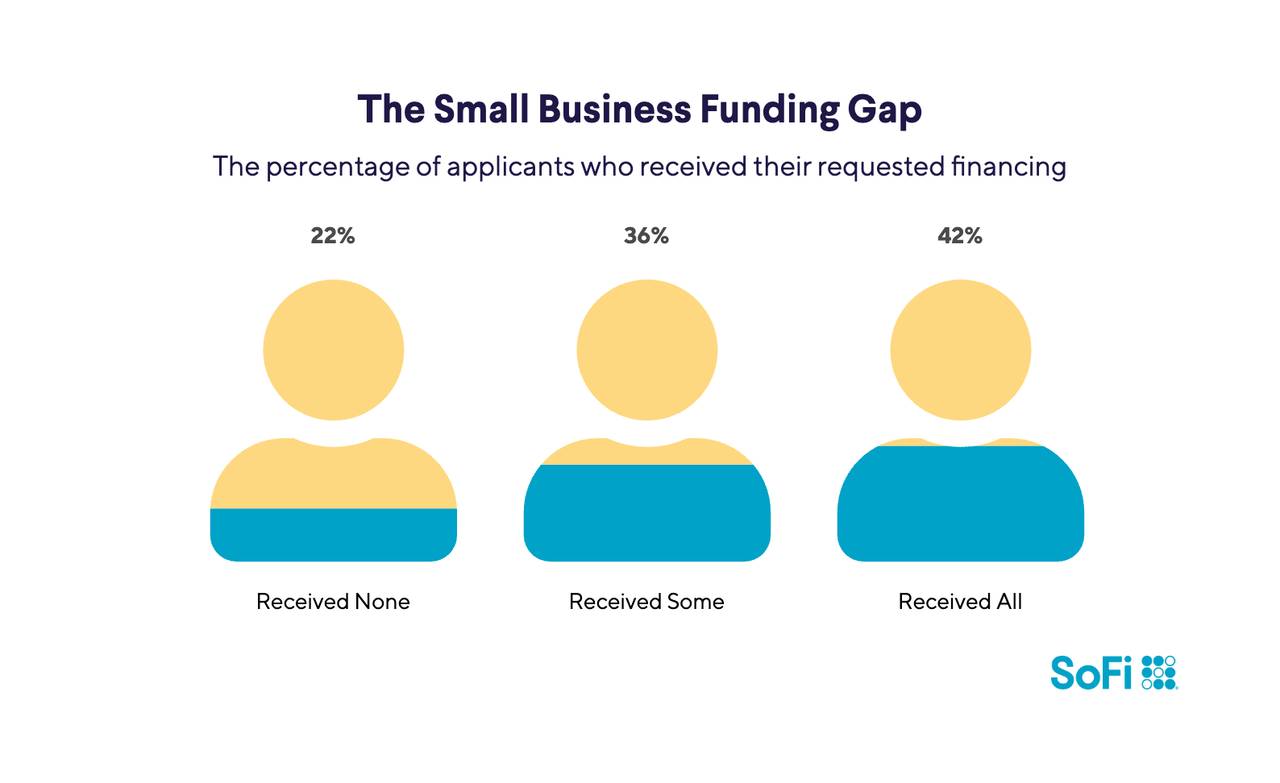
- Access to capital remains a barrier, as only 42% of small business applicants received all the financing they sought in the latest Federal Reserve survey.
- Artificial intelligence adoption is accelerating, with SoFi research finding that 75% of small business owners report they have adopted at least one AI tool.
- Rising costs are the top financial pressure, yet owners stay resilient. SoFi research finds that nearly 40% of microbusiness owners feel very positive about their future.
- Women-owned businesses keep growing while facing distinct funding and networking challenges, according to a SoFi survey.
The State of Small Business in 2026
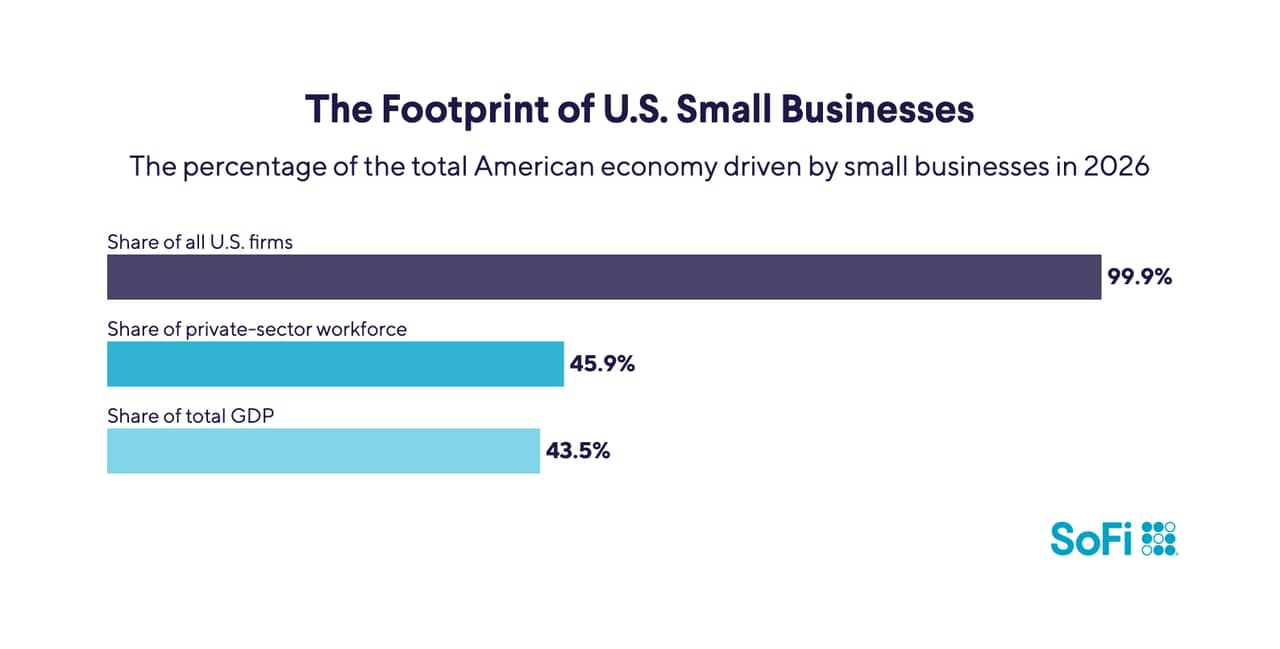
Small business statistics from the SBA tell a story of resilience under pressure. The U.S. has about 36.2 million small businesses, which represent 99.9% of all firms and employ 62.3 million people, or 45.9% of the private-sector workforce. Together, they’re estimated to generate about 43.5% of the total gross domestic product (GDP).
SoFi
But behind those totals, owners are working in a tougher operating environment. Inflation and higher input costs top the list of financial challenges, borrowing costs remain elevated, and finding qualified staff is a persistent strain. Many owners are balancing growth ambitions against tighter margins, while technology and AI in particular are reshaping how even the smallest firms operate.
The SBA describes the current climate as one of cautious resilience, marked by stable employment and continued business formation alongside real headwinds from inflation and economic uncertainty.
That mix of ambition and constraint is why benchmarking is important. Most small business statistics are national totals, but comparing your revenue, financing, and staffing against countrywide data helps separate business-specific issues from industry-wide trends.
Whether you are scaling an established firm or starting a small business, the figures that follow offer a grounded baseline for decision-making and understanding whether a slow quarter is an issue with your business or the broader economy.
Business Formation Landscape
One of the clearest small business growth statistics is how durable entrepreneurship has become.
- New business applications remain well above pre-2020 levels, with about 524,000 applications filed in May 2026. (SBA and NFIB)
- Of the 36.2 million small businesses in the country, 82.3% (29.8 million) are nonemployer firms with no paid staff, while 17.7% (6.4 million) have employees. (SBA)
- The nonemployer segment has nearly doubled since 1997, when it stood at 15.4 million. (SBA)
- The number of small employer firms, meanwhile, has grown every year since 2011. (SBA)
Formation is broad-based across industries, with retail trade, professional services, and construction among the sectors drawing the most new applications, according to the Census Bureau. First-time founders sizing up where to start can look into ideas for small businesses against this formation data to see where the opportunity is strongest.
Small Business Survival Rates and Failure Statistics
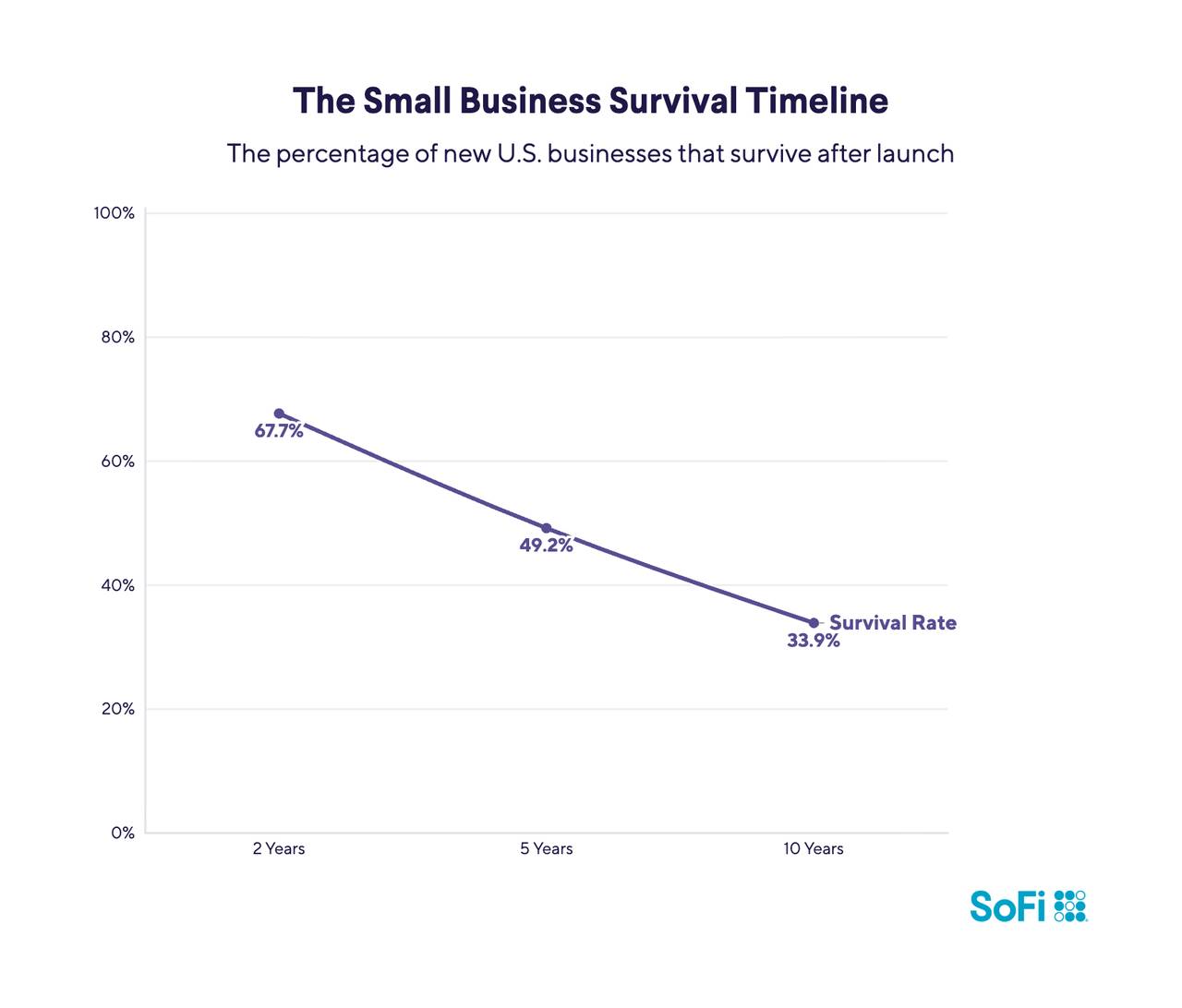
Strong formation numbers tell only part of the story. The most useful small business success statistics track what happens after launch. About 67.7% of new businesses survive at least two years, 49.2% reach five years, and 33.9% make it to a decade, according to the SBA.
Survival odds improve with time. Among businesses that reach the five-year mark, 69.5% go on to reach 10 years. Turnover remains a normal feature of the economy, with about 1.3 million establishments opening and 1.2 million closing in 2023.
SoFi
Failure is rarely about a single misstep. The Federal Reserve reports that rising costs, thin cash reserves, and difficulty reaching customers rank among the most common pressures owners report. That’s why planning, funding, and adaptability matter so much. Understanding the reasons small businesses fail can help you spot warning signs early and adjust before problems compound.
Employment and Economic Impact
Small businesses employ 62.3 million people, equal to 45.9% of all private-sector workers. But their contribution to job growth is even greater. Between 1995 and 2024, the SBA reports that small businesses created 20.7 million net new jobs, compared with 13.2 million at large businesses, accounting for 61% of net new job creation over that period.
The economic footprint extends beyond payroll. Small firms generate 43.5% of the GDP and account for 38.7% of private-sector payroll, or about $3.5 trillion. They also dominate certain corners of the economy, making up 97.2% of exporters.
Financing and Capital Access Statistics
Capital access impacts nearly every other small business growth statistic, as it determines whether a firm can hire, expand, or simply weather a slow quarter.
SoFi
According to the Federal Reserve:
- Nearly 2 out of 5 (38%) small employer firms applied for a loan, line of credit, or merchant cash advance in the prior year.
- Owners most often sought funding to cover operating expenses (56%) or to pursue expansion (46%).
- Approval gaps persist, and just 42% of applicants received all the financing they requested, while 36% got some and 22% received none.
- The share turning to online fintech lenders climbed from 17% in 2020 to 29% in 2025.
SoFi’s research underscores how uneven access can be. Only 18% of women business owners used a business or SBA loan to launch, relying instead on personal savings. Among Hispanic-owned businesses, 40% report needing a second job to make ends meet.
Banking and Cash Flow Statistics
Day-to-day small business stats reveal where the strain of managing cash shows up. Rising costs of goods, services, and wages were the most common financial challenge owners reported in the Federal Reserve’s 2026 survey, and more than 2 in 5 also cited higher tariff-related costs, with 77% reporting one or both.
SoFi’s microbusiness research paints a similar picture, with 46% of owners naming rising costs as their toughest problems of the past year and 37% naming economic uncertainty. To stay afloat, many lean on personal resources, evidenced by the 40% of Hispanic business owners who say they work a second job to make ends meet.
The encouraging counterpoint is resilience. Despite the numbers above, nearly 40% of microbusiness owners told SoFi they feel very positive about their future, and most respond to pressure by adjusting prices or hours rather than retreating.
When revenue lags expenses, tools like working capital loans or a business line of credit can help owners cover expenses without stalling growth.
Demographics of Small Business Owners
One of the more striking small-business growth statistics is how steadily entrepreneurship keeps diversifying across the United States.
SoFi
Census Bureau data on business owners shows:
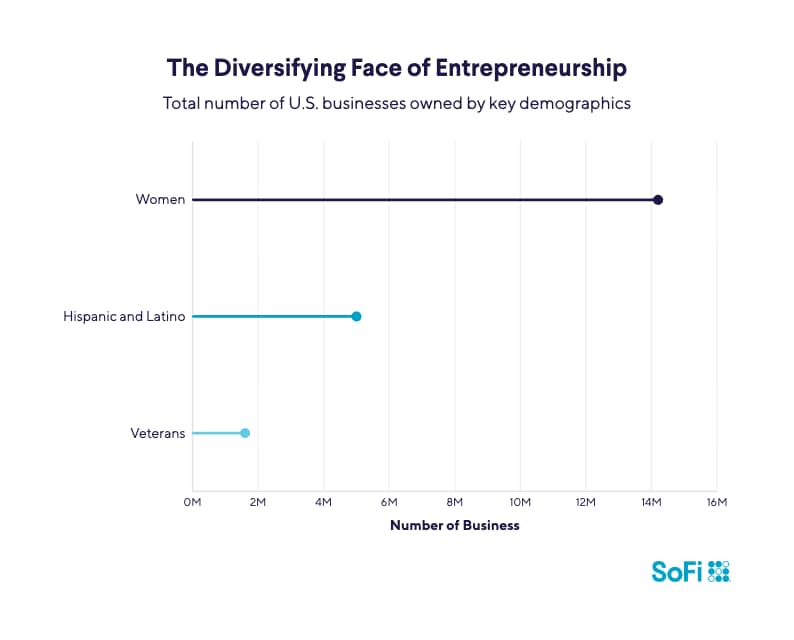
- Women own roughly 14.2 million businesses, about 39% of all U.S. businesses, while also accounting for 42.3% of nonemployer firms.
- Veteran-owned businesses totaled around 1.6 million of all U.S. businesses, and 261,000 of those have at least one paid employee.
Hispanic and Latino entrepreneurs are among the fastest-growing groups, with SoFi’s research showing roughly 5 million businesses nationwide. One-third of those owners launched amid the COVID-19 pandemic.
Support and funding challenges persist, though. In SoFi’s research, 68% of women business owners named networking and finding a mentor as their top challenge, more than twice as hard as securing funding.
For owners weighing how to structure or fund a new venture, looking into the different types of business structures and small business grant applications are useful starting points.
Mompreneurs and Business-Owning Parents
Some of the most striking small business success statistics come from parents who build companies around their families. In SoFi’s survey of business-owning mothers, 66% said creating generational wealth for their children was a major reason they launched. Nearly half (48%) expect their children to take over the business one day.
The path is not always smooth. More than 60% of these owners said they felt judged for pursuing entrepreneurial goals while parenting.
Yet many credit parenthood with sharpening the skills that running a business demands. Respondents said being a parent improved their problem-solving (60%), multitasking (51%), and resilience (46%).
The takeaway is that for many parents, entrepreneurship is less a trade-off with family life than an extension of it, offering flexibility, autonomy, and a legacy to pass on.
AI and Technology Adoption Among Small Businesses
Few small business statistics have moved as fast as AI adoption. According to SoFi data, 75% of small businesses reported using at least one AI tool, citing efficiency gains alongside security concerns.
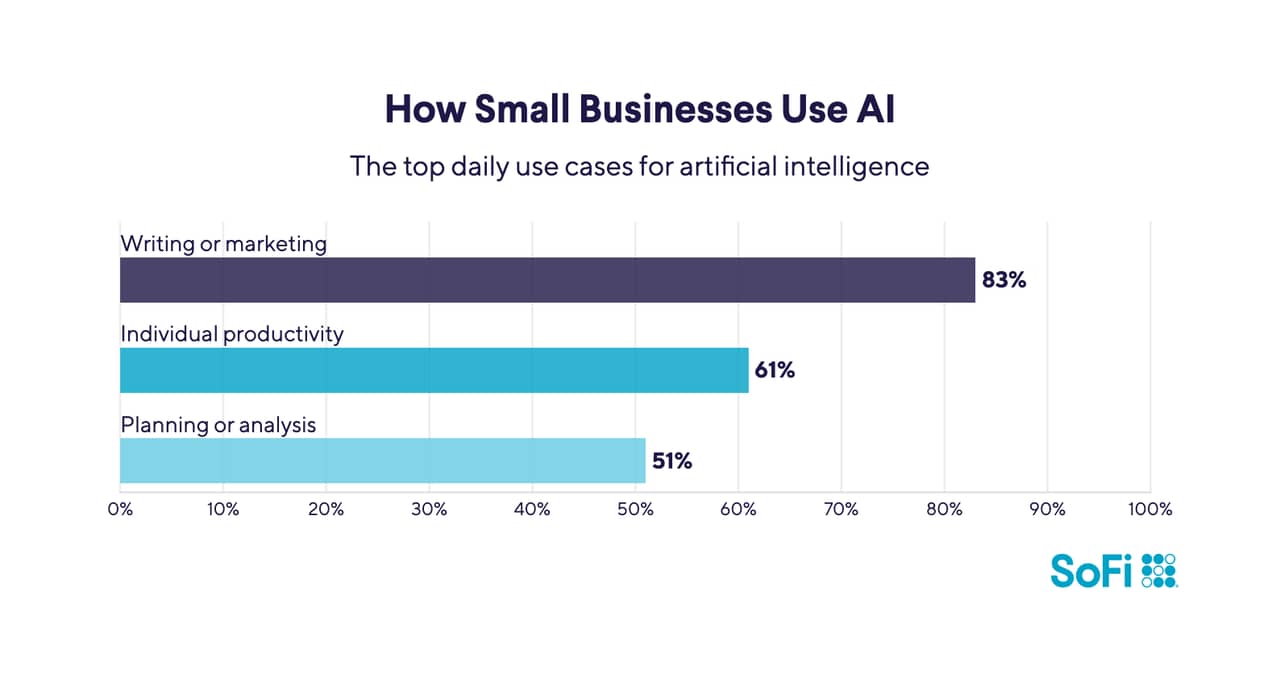
Federal Reserve data shows how that adoption translates into daily work. Among employer firms, 46% currently use AI, most often for writing or marketing (83%), individual productivity (61%), and planning or analysis (51%). The payoff is concrete, with 71% of AI users reporting increased productivity and 31% pointing to higher sales.
SoFi
Concerns temper the enthusiasm. Owners cite accuracy and the effort of adapting tools to their needs as leading obstacles, and data privacy remains top of mind.
For owners deciding where AI fits into their own business, grounding the decision in business fundamentals can help differentiate practical use cases from hype.
Small Business Sentiment and Economic Conditions
The broadest statistics about small businesses capture mood as much as money. The NFIB Small Business Optimism Index stood at 95.9 in April 2026, below its 52-year average of 98 for a second straight month.
Specific worries dominate. Labor quality was owners’ single most important problem at 18%, followed by taxes and inflation, and 34% reported job openings they could not fill. Expectations have cooled, too, with the Federal Reserve noting that owners’ outlook for future revenue and employment growth fell to its lowest level since 2020.
More than a Statistic: What Small Business Owners Mean for the Future of America
Taken together, these small business statistics describe an economy still powered by its smallest players. Formation remains strong despite uncertainty, owners continue to adapt through technology adoption and operational efficiency, and millions of new applications each year are a sign of continued confidence in the idea of building something independent.
The challenges are just as clear: Capital access, cash flow, and long-term planning remain the levers that separate businesses that merely survive from those that grow. Owners who benchmark their numbers against national data and line up funding before they need it are in a good spot for what comes next.
Small businesses are the employers, innovators, and community anchors that shape local economies across the country. Behind every statistic in this piece is an owner making decisions about how to grow, hire, and stay resilient.
Disclaimer: Figures reflect the most recent releases available as of June 2026; survey vintages vary by dataset.
This story was produced by SoFi and reviewed and distributed by Stacker.


