Child Care Market to Reach USD 462.18 Billion by 2035, Driven by Digital & Hybrid Care at 5.65% CAGR
The Child Care Market is projected to reach USD 462.18 billion by 2035 at a 5.65% CAGR, driven by flexible, digital and
Press Release Disclaimer: This is a press release distributed through the XPR Media network. It has not been independently verified by our newsroom.
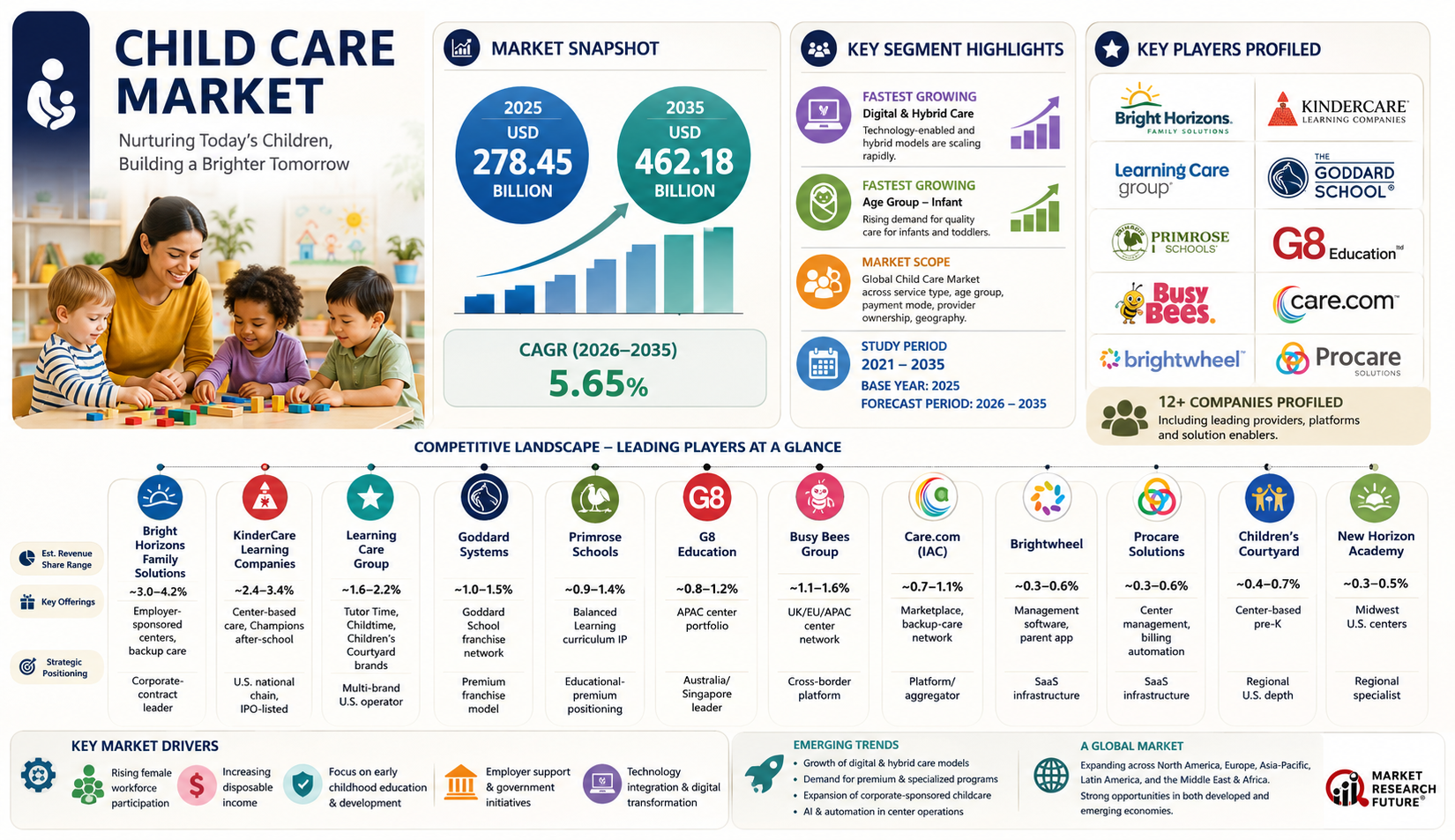

The Child Care Market is projected to reach USD 462.18 billion by 2035 at a 5.65% CAGR, driven by flexible, digital and employer-supported care.
NEW YORK, NY, UNITED STATES, August 24, 2026 /EINPresswire.com/ — The global Child Care Market is undergoing structural changes as families, employers, governments, and care providers respond to evolving workforce participation, urbanization, household needs, and expectations around early childhood development. The market encompasses organized and informal care solutions designed for children across different age groups, ranging from infants to school-age children. Increasing demand for dependable supervision, early learning, after-school programs, backup care, and flexible arrangements is broadening the role of child care beyond conventional center-based services. The market is projected to expand from USD 278.45 billion in 2025 to USD 462.18 billion by 2035, registering a 5.65% CAGR from 2026 to 2035.
The competitive landscape remains fragmented despite the presence of major organized operators and technology-enabled platforms. Companies such as Bright Horizons Family Solutions, KinderCare Learning Companies, Learning Care Group, Goddard Systems, Primrose Schools, G8 Education, Busy Bees Group, Care.com, Brightwheel, Procare Solutions, Children’s Courtyard, and New Horizon Academy compete through center networks, curriculum offerings, employer-sponsored programs, franchise models, digital platforms, and management technology. Bright Horizons maintains a strong position in employer-sponsored and backup care, while KinderCare and Learning Care Group have substantial center-based operations. Goddard and Primrose emphasize premium and education-oriented franchise models, whereas G8 Education and Busy Bees provide significant international and regional exposure. Technology providers such as Brightwheel and Procare Solutions increasingly support the underlying operational infrastructure of child care providers.
“Free Sample Copy” – Access A Complimentary Copy of Our Report to Explore Its Content and Insights
https://www.marketresearchfuture.com/sample_request/12008
Key Market Growth Drivers
One of the most important growth drivers is the increasing need for flexible child care arrangements. Modern employment patterns include hybrid work, variable schedules, extended working hours, and nontraditional employment structures. These patterns can make fixed-hour care less suitable for some households. As a result, providers are expanding options such as extended-day programs, backup care, after-school services, digital coordination, and hybrid care models.
Employer-supported child care is another significant contributor. Businesses increasingly view access to reliable care as relevant to employee retention, workforce participation, productivity, and absenteeism management. Employer-sponsored centers and backup-care networks therefore represent an important service model, particularly for organizations with large employee populations.
Early childhood development is also influencing purchasing decisions. Parents increasingly evaluate child care providers based not only on supervision but also on learning environments, developmental activities, curriculum structure, safety practices, communication, and staff capabilities. This creates opportunities for providers that combine care with structured early education.
Child Care Market Segment Analysis
By Service Type
The service type segment includes center-based care, family child care, preschool and early education, before- and after-school care, nanny and in-home care, backup care, and digital or hybrid solutions. Center-based care remains a core component because it offers structured facilities, scheduled programs, professional staffing, and standardized operating procedures.
Family-based and in-home care provide greater personalization and flexibility, making them relevant for households seeking smaller settings or customized schedules. Before- and after-school programs address the needs of working parents whose schedules extend beyond regular school hours.
Backup care is gaining importance because families can experience temporary disruptions when their regular caregiver becomes unavailable. Employer-sponsored backup care can address this gap while also supporting workforce continuity.
The Digital & Hybrid Care segment is identified as one of the fastest-growing areas. Digital platforms can assist with caregiver discovery, scheduling, communication, payments, attendance, and parent engagement, while hybrid models combine physical care with digital coordination and supplementary learning resources.
By Age Group
The age group segment covers infants, toddlers, preschool-age children, and school-age children. Infants require specialized attention because of their feeding, sleeping, health, supervision, and developmental needs. Consequently, infant care can require lower child-to-caregiver ratios and specialized facilities.
The Infant Age Group represents one of the fastest-growing segments as demand for reliable early-stage care increases among working households. Toddler care similarly requires structured supervision and developmental activities, while preschool programs increasingly combine care with foundational learning.
School-age care differs from infant and preschool services because it often centers on before-school, after-school, holiday, and enrichment programs. Providers offering multiple age-specific services can therefore serve households throughout different stages of childhood.
By Payment Mode
Payment models include private-pay, employer-sponsored, government-supported, and mixed or subsidized arrangements. Private-pay remains a fundamental mechanism in many markets, with households directly paying providers for regular child care services.
Employer-sponsored payment is increasingly relevant as organizations explore benefits that can help employees manage caregiving responsibilities. Depending on the market, government-supported or subsidized programs can improve affordability and expand access for qualifying families.
Mixed payment arrangements can combine household contributions with employer or public support. The evolution of payment structures is particularly important because affordability remains a key consideration in child care purchasing decisions.
By Provider Ownership
The market can be divided into private, public, nonprofit, franchise, and independently operated providers. Private operators often compete through service quality, location, curriculum, operating hours, and specialized programs. Large chains benefit from standardized processes, established brands, centralized technology, and purchasing efficiencies.
Franchise-based models such as those associated with Goddard Systems and Primrose Schools allow providers to expand through local operators while maintaining defined brand and curriculum standards. Independent providers, meanwhile, can differentiate through community relationships, smaller-scale operations, and localized services.
Public and nonprofit providers remain important in markets where child care is connected with social programs, early education, or community support. The balance among these ownership models varies significantly by geography.
By Geography
Geographically, the global market spans North America, Europe, Asia-Pacific, and other international markets, with demand shaped by demographic patterns, employment structures, child care policies, disposable income, urbanization, and availability of organized services.
North America has a mature organized provider ecosystem and a strong presence of center-based operators, employer-sponsored care, franchise networks, and technology platforms. The United States represents an important market for companies such as Bright Horizons, KinderCare, Learning Care Group, Goddard Systems, and Primrose Schools.
Europe features a diverse child care landscape influenced by national policies, public funding mechanisms, and established provider networks. Companies such as Busy Bees have developed cross-border exposure across multiple markets.
Asia-Pacific presents substantial opportunities due to urbanization, changing household structures, workforce participation, and expanding demand for organized early childhood services. G8 Education provides an important regional presence, particularly through its Australia-focused portfolio.
Emerging markets can offer additional long-term opportunities as organized child care infrastructure develops and families increasingly seek formal early learning and care services.
Technology and Digital Transformation
Technology is becoming an important layer of the Child Care Market rather than a standalone service category. Child care management platforms can automate billing, enrollment, attendance, staff administration, parent communication, and reporting. Parent-facing applications can provide updates and facilitate communication between families and providers.
Companies such as Brightwheel and Procare Solutions illustrate the expanding role of software infrastructure. Digital platforms can also improve operational visibility for multi-location operators and help providers manage administrative workloads. Over time, technology is expected to contribute to more integrated child care ecosystems combining physical facilities, digital communication, scheduling, payments, and data-driven administration.
“Proceed To Buy” – Move Forward with Your Purchase and Gain Instant Access to the Complete Report
https://www.marketresearchfuture.com/checkout?currency=one_user-USD&report_id=12008
Competitive Landscape and Key Players
Competition is characterized by a combination of scale, geographic reach, service specialization, curriculum differentiation, employer relationships, franchise expansion, and technology integration. Bright Horizons is positioned strongly around employer-sponsored centers and backup care, while KinderCare maintains a broad U.S. center-based network and after-school offerings. Learning Care Group operates multiple recognized brands, providing a diversified approach to center-based child care.
Goddard Systems and Primrose Schools emphasize franchise-led expansion and education-oriented positioning. G8 Education has significant APAC exposure, while Busy Bees operates across international markets. Care.com brings a platform and marketplace orientation, connecting families with care solutions. Brightwheel and Procare Solutions operate further upstream by providing software infrastructure to child care centers. Regional specialists such as Children’s Courtyard and New Horizon Academy add further competition within specific U.S. markets.
The market therefore includes both traditional care operators and technology-enabled businesses. Future competition is likely to focus increasingly on service flexibility, caregiver availability, operational efficiency, parent experience, affordability, and the ability to integrate physical and digital care services.
Future Outlook
The global Child Care Market is expected to maintain steady expansion through 2035, supported by evolving family structures, workforce participation, demand for early childhood development, employer involvement, and technology adoption. The transition toward digital and hybrid care could reshape how families discover, schedule, monitor, and pay for services, while infant care remains an important area of specialized demand.
At the same time, providers will need to address operational challenges such as staffing, affordability, regulatory requirements, capacity constraints, and service quality. Companies capable of combining reliable physical care with technology-enabled convenience and strong educational offerings are positioned to participate in the market’s long-term development.
Overall, the market’s expansion from USD 278.45 billion in 2025 to USD 462.18 billion by 2035 highlights the growing economic importance of child care services. With a 5.65% CAGR during 2026–2035, the industry is moving toward a more diversified ecosystem where center-based care, specialized infant services, employer-supported programs, franchise networks, and digital platforms operate alongside one another.
Frequently Asked Questions
1. What is the projected size of the Child Care Market by 2035?
The global Child Care Market is projected to reach USD 462.18 billion by 2035, expanding at a 5.65% CAGR from 2026 to 2035.
2. Which segments are expected to grow fastest in the Child Care Market?
Digital & Hybrid Care and the Infant Age Group are identified as the fastest-growing segments, supported by demand for flexible services, technology-enabled coordination, and specialized early-stage care.
Read Our Related Research Report
Baby Mattresses Market –
https://www.marketresearchfuture.com/reports/baby-mattresses-market-24047
Baby Toys Market –
https://www.marketresearchfuture.com/reports/baby-toys-market-1559
Baby Safety Products Market –
https://www.marketresearchfuture.com/reports/baby-safety-products-market-11634
Organic Baby Bathing Products Market –
https://www.marketresearchfuture.com/reports/organic-baby-bathing-product-market-3998
Baby Cradle Market –
https://www.marketresearchfuture.com/reports/baby-cradle-market-10785
Sagar Kadam
Market Research Future
+1 628-258-0071
email us here
Legal Disclaimer:
EIN Presswire provides this news content “as is” without warranty of any kind. We do not accept any responsibility or liability
for the accuracy, content, images, videos, licenses, completeness, legality, or reliability of the information contained in this
article. If you have any complaints or copyright issues related to this article, kindly contact the author above.

Media gallery