Empirical Security Launches Foundation V2 as AI Floods Security Teams With New Vulnerabilities
New exploit prediction model is 9.5x better at predicting exploitation in a vulnerability's first seven days AI has
Press Release Disclaimer: This is a press release distributed through the XPR Media network. It has not been independently verified by our newsroom.

New exploit prediction model is 9.5x better at predicting exploitation in a vulnerability’s first seven days
CHICAGO, IL, UNITED STATES, November 18, 2026 /EINPresswire.com/ — Empirical Security, creator of the industry’s first models focused on prediction and prioritization, today announced Foundation V2, a new version of its global model for predicting which vulnerabilities will be exploited in the next 30 days.
Severity can’t keep pace with AI-driven discovery
AI uncovers vulnerabilities faster than any team can patch them, and the number of published CVEs keeps surging. Most security programs still face that flood armed with legacy tools spitting out severity scores, ones that don’t take context into account and aren’t opinionated about the likelihood of actual exploitability.
Foundation V2 answers a different question than severity scores: how likely is this vulnerability to be exploited in the next 30 days? It returns a calibrated probability, updated as the threat landscape changes, so teams have a data-driven way to prioritize and remediate the most dangerous threats.
More needles, less hay
Foundation V2 adds nearly 300 new model inputs and three new exploitation sources. Measured against Foundation V1, the results are:
– 9.5x better at predicting exploitation in a vulnerability’s first seven days
– 24% better at predicting exploitation in the next 30 days across all CVEs
– 2.2x better at spotting vulnerabilities that return to exploitation after more than a month of silence
– 1.9x better at recognizing when exploitation attempts are about to halt
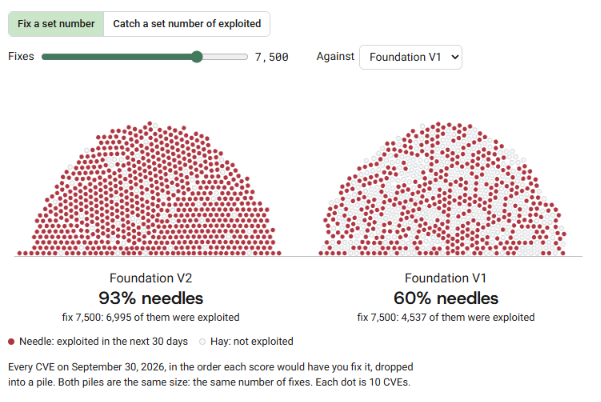
The difference is clearly apparent in the amount of remediation that resource-strapped teams have to do. With a fixed budget of 7,500 fixes, teams prioritizing with Foundation V2 fix a vulnerability exploited in the wild within 30 days 93% of the time, compared with only 60% for the prior version of the model. (For comparison, teams using CVSS hit only 5%).
Friends don’t let friends prioritize with scanners alone
Many security teams rely on their vulnerability scanners for prioritization, which can have devastating consequences. Here’s a simple comparison.
Empirical ranked every CVE as of September 30, 2026 in the order each score that Foundation, Qualys, and Tenable would have awarded them to help security teams with prioritization, and gave each hypothetical security team the same budget of 7,500 fixes.
Foundation V2’s list held 6,995 vulnerabilities exploited in the wild within 30 days, a 93% hit rate. Qualys QVS’s list held 3,354, or 45%, and Tenable VPR’s held 1,975, or 26%.
In short, for the same effort, Foundation V2 closed twice as many exploited vulnerabilities as Qualys and three and a half times as many as Tenable. Most of the scanner-prioritized fixes were wasted on vulnerabilities that no attacker bothered to touch.
The future of exposure management is Probability
“AI has changed the math on exposure management,” said Ed Bellis, co-founder and CEO of Empirical Security. “Discovery is accelerating, attackers are moving faster and severity scores were never built to tell you what gets exploited next. The teams that win will prioritize based on probability. Foundation V2 gives them a number they can trust, budget against, and defend.”
Foundation V2 also powers Empirical’s Radiant models, which build on the global model with each organization’s own telemetry, controls and asset data to produce a probability calibrated to that specific environment. A stronger Foundation model means sharper local models for every Radiant customer.
Foundation V2 is available now to all Empirical Security customers.
Greg Howard
Empirical Security
gregh@empiricalsecurity.com
Visit us on social media:
LinkedIn
Legal Disclaimer:
EIN Presswire provides this news content “as is” without warranty of any kind. We do not accept any responsibility or liability
for the accuracy, content, images, videos, licenses, completeness, legality, or reliability of the information contained in this
article. If you have any complaints or copyright issues related to this article, kindly contact the author above.

Media gallery