
65% of U.S. Parents Surveyed Think “Human Milk Fortifier” Contains Donor Human Milk; Yet Only One Does
DUARTE, Calif., Nov. 12, 2026
Press Release Disclaimer: This is a press release distributed through the XPR Media network. It has not been independently verified by our newsroom.

65% of U.S. Parents Surveyed Think “Human Milk Fortifier” Contains Donor Human Milk; Yet Only One Does
PR Newswire
DUARTE, Calif., Nov. 12, 2026
New survey finds even parents whose babies spent time in the NICU are confused about what premature infants are fed
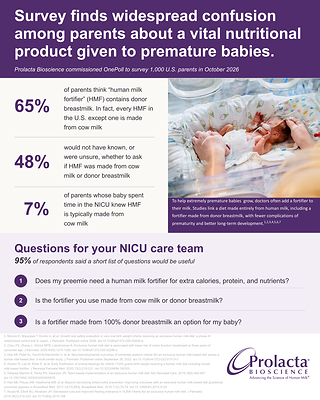
DUARTE, Calif., Nov. 12, 2026 /PRNewswire/ — A new national survey released for Prematurity Awareness Month by Prolacta Bioscience finds widespread confusion among parents about a vital nutritional product often given to premature babies in the neonatal intensive care unit (NICU). The product is labeled “Human Milk Fortifier.” Two in three U.S. parents (65%) think the name means it contains donor breastmilk. In fact, every human milk fortifier used in the U.S. is made from cow milk, except for one.
The confusion starts with the label itself. “Human Milk Fortifier” was originally intended to describe what the product is added to, not what it’s made from. Many parents don’t realize there are two types of these fortifiers, one made from donor breastmilk and all the others made from cow milk. Even parents whose babies spent time in the NICU are confused: 66% think human milk fortifiers contain donor breastmilk, and only 7% knew it is typically made from cow milk.
Premature babies, especially those born weighing 2.75 pounds or less, need more calories, protein, and nutrients than breastmilk alone can provide. To help them grow, doctors often add a fortifier to their milk. Studies over the past 20 years link a diet made entirely from human milk, including a fortifier made from donor breastmilk, with fewer complications of prematurity and better long-term development.1-7 Prolacta Bioscience, which commissioned the survey, makes the only human milk fortifier in the U.S. made from donor breastmilk, free from cow milk. More than half of Level III and IV NICUs in the U.S. used Prolacta fortifiers in 2026.8
Almost all parents surveyed (95%) said a short list of feeding questions would be useful, rising to 98% among parents whose baby spent time in the NICU. To help parents ask key questions during their NICU journey, Prolacta has created a free guide parents can use with their NICU care team, available at parents.prolacta.com. Other survey findings:
- Nearly half of parents surveyed (48%) would not have known, or were unsure, whether to ask if their premature baby’s added nutrition was made from cow milk or donor breastmilk.
- 70% of NICU parents said they would know what to ask about a premature baby’s feeding needs, yet only 7% knew human milk fortifier is typically made from cow milk.
- 93% said it would be important for a premature baby to reach the same developmental milestones as a baby born full term.
Early NICU Nutrition Shapes Long-Term Development
Since a premature baby’s brain is growing so quickly, the nutrition they receive in their first weeks of life can shape their long-term development.9-11 A 2025 study of more than 1,000 infants across 13 Southern California NICUs found that preemies who received Prolacta’s fortifiers as part of an exclusive human milk diet (EHMD) were significantly less likely to have motor skill delays at age 3.2 These motor skills help toddlers walk, run, climb, and explore their world, in step with other children their same age. A separate study conducted in 2022 found that babies fed an EHMD had significantly higher cognitive scores (thinking, learning, attention) at 18 to 22 months corrected age than babies fed cow milk-based products.3
In December of 2025, Japan approved Prolacta’s fortifiers as prescription drugs, a world first in neonatal nutritional care, following the successful completion of a Phase III clinical trial in Japan.1 Given Japan’s longstanding leadership role in advancing neonatal care globally, this drug designation affirms Prolacta’s rigorous quality and safety standards, a level of assurance that matters to U.S. parents, too. In the survey, 87% of U.S. parents said they would want their premature baby to have access to a donor breastmilk-based product that met the quality standards required for prescription medicine.
“An early birth can introduce nutrition decisions families never expected to face,” said Melinda Elliott, MD, FAAP, neonatologist and chief medical officer at Prolacta. “Parents deserve clear, plain-language information about the nutritional fortifier their baby receives, the evidence behind the available options, and the questions they can discuss with their NICU care team. One of the most important questions is simple: Is my baby’s fortifier made from cow milk or human milk?”
Frequently Asked Questions
Who was surveyed?
Prolacta commissioned OnePoll to conduct the online survey of 1,000 U.S. parents whose first child is age 4 or younger, including 125 parents whose child spent time in the NICU. The survey was fielded October 13-21, 2026, and included parents across the Midwest, Northeast, Southeast, Southwest, and West.
Where can I find a list of feeding questions to discuss with my baby’s care team?
Prolacta has developed a free guide to help parents understand the nutritional needs of premature infants and discuss feeding options with their NICU team.
Where can I learn more?
Parents can find more information and educational resources at parents.prolacta.com.
About Prolacta Bioscience
Prolacta Bioscience® is the global leader in human milk-based nutrition, dedicated to improving health outcomes for critically ill and premature infants. More than 125,000 vulnerable infants worldwide have benefited from Prolacta’s human milk-based fortifiers and formulas since 2006.12 In a global first, Japan granted prescription drug status to Prolacta’s PreemieFort® fortifiers in late 2025 for very low birthweight infants, infants with congenital gastrointestinal disorders or congenital heart disease, and those recovering from gastrointestinal surgery at risk for poor growth. Prolacta adheres to the industry’s strictest quality and safety standards, operating pharmaceutical processing facilities and applying more than 20 donor milk screening tests. Its use of vat pasteurization inactivates pathogens while keeping human milk closer to its natural state than other human milk processing methods, preserving the bioactive components of human milk that support immune protection, brain development, and growth in premature and medically fragile infants.13-15 Prolacta’s products have been evaluated in more than 30 peer-reviewed clinical studies, demonstrating the short- and long-term health benefits of its patented human milk-based fortifiers and formulas. Learn more online or at X, Instagram, Facebook, TikTok, and LinkedIn.
# # #
Media Contact:
Loren Kosmont
Lkosmont@prolacta.com
310-721-9444
|
References |
|
|
1 |
Mizuno K, Miyazawa T, Kondo U, et al. Growth and safety evaluation in very low birth weight infants receiving an exclusive human milk diet: a phase III randomized control trial in Japan. J Perinatol. Published online 2026. doi:10.1038/s41372-026-02695-w |
|
2 |
Chou FS, Zhang J, Villosis MFB, Lakshmanan A. Exclusive human milk diet is associated with lower risk of motor function impairment at three years of corrected age. J Perinatol. 2025;45(9):1274-1280. doi:10.1038/s41372-025-02296-z |
|
3 |
Hair AB, Patel AL, Kiechl-Kohlendorfer U, et al. Neurodevelopmental outcomes of extremely preterm infants fed an exclusive human milk-based diet versus a bovine milk-based diet: a multi-center study. J Perinatol. Published online September 28, 2022. doi:10.1038/s41372-022-01513-3 |
|
4 |
Huston R, Lee M, Rider E, et al. Early fortification of enteral feedings for infants <1250 grams birth weight receiving a human milk diet including human milk-based fortifier. J Neonatal Perinatal Med. 2020;13(2):215-221. doi:10.3233/NPM-190300 |
|
5 |
Delaney Manthe E, Perks PH, Swanson JR. Team-based implementation of an exclusive human milk diet. Adv Neonatal Care. 2019;19(6):460-467. doi:10.1097/ANC.0000000000000676 |
|
6 |
Hair AB, Peluso AM, Hawthorne KM, et al. Beyond necrotizing enterocolitis prevention: improving outcomes with an exclusive human milk-based diet [published correction appears in Breastfeed Med. 2017;12(10):663]. Breastfeed Med. 2016;11(2):70-74. doi:10.1089/bfm.2015.0134 |
|
7 |
Assad M, Elliott MJ, Abraham JH. Decreased cost and improved feeding tolerance in VLBW infants fed an exclusive human milk diet. J Perinatol. 2016;36(3):216-220. doi:10.1038/jp.2015.168 |
|
8 |
Data on file. Number of U.S. hospitals that used Prolacta’s fortifiers and formulas in 2026. |
|
9 |
Bergner EM, Shypailo R, Visuthranukul C, et al. Growth, body composition, and neurodevelopmental outcomes at 2 years among preterm infants fed an exclusive human milk diet in the neonatal intensive care unit: a pilot study. Breastfeed Med. 2020;15(5):304-311. doi:10.1089/bfm.2019.0210 |
|
10 |
Rahman A, Kase J, Murray Y, et al. Neurodevelopmental outcome of extremely low birth weight infants fed an exclusive human milk diet is not affected by growth velocity. Breastfeed Med. 2020;15(6):362-369. doi:10.1089/bfm.2019.0214 |
|
11 |
Visuthranukul C, Abrams SA, Hawthorne KM, et al. Premature small for gestational age infants fed an exclusive human milk-based diet achieve catch-up growth without metabolic consequences at 2 years of age. Arch Dis Child Fetal Neonatal Ed. 2018;0:F1-F6. doi:10.1136/archdischild-2017-314547 |
|
12 |
Data on file. Estimated number of premature infants fed Prolacta’s products from January 2007 to May 2025. |
|
13 |
Ozturk G, Paviani B, Rai R, et al. Investigating milk fat globule structure, size, and functionality after thermal processing and homogenization of human milk. Foods. 2024;13(8):1242. doi:10.3390/foods13081242 |
|
14 |
Liang N, Koh J, Kim BJ, Ozturk G, Barile D, Dallas DC. Structural and functional changes of bioactive proteins in donor human milk treated by vat-pasteurization, retort sterilization, ultra-high-temperature sterilization, freeze-thawing and homogenization [published correction appears in Front Nutr. 2024;11:1371799]. Front Nutr. 2022;9:926814. doi:10.3389/fnut.2022.926814 |
|
15 |
Meredith-Dennis L, Xu G, Goonatilleke E, Lebrilla CB, Underwood MA, Smilowitz JT. Composition and variation of macronutrients, immune proteins, and human milk oligosaccharides in human milk from nonprofit and commercial milk banks. J Hum Lact. 2018;34(1):120-129. doi:10.1177/0890334417710635 |

 View original content to download multimedia:https://www.prnewswire.com/news-releases/65-of-us-parents-surveyed-think-human-milk-fortifier-contains-donor-human-milk-yet-only-one-does-302937141.html
SOURCE Prolacta Bioscience


