With AWS Hackathon Win, TASKING-Led Team Demonstrates the Future of Automotive Safety-Critical Software Development
Working prototype of a governed agentic AI workflow earns the competition's highest score for OEM purchase readiness by
Press Release Disclaimer: This is a press release distributed through the XPR Media network. It has not been independently verified by our newsroom.


A cross-organizational team bringing together expertise from TASKING, Infineon and the German Aerospace Center (DLR) earned the top award at the AWS “Accelerating the V-Cycle with Agentic AI” hackathon for demonstrating a governed AI-assisted engineering workflow that reimagines software-defined vehicle development. The working prototype received the competition’s highest score for OEM purchase readiness, validating a new approach to connecting trusted semiconductor products and knowledge with implementation, compliance, testing and verification across the automotive V-cycle.
This press release features multimedia. View the full release here: https://www.businesswire.com/news/home/20260818770734/en/
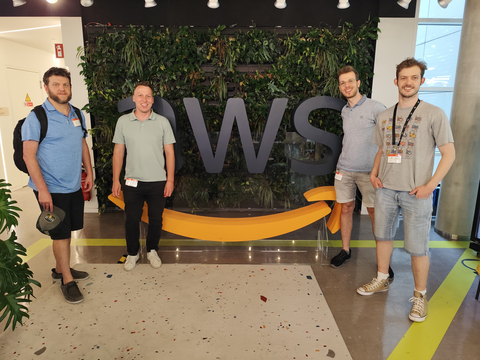
The winning team from TASKING, Infineon and the German Aerospace Center received the competition’s highest score for OEM purchase readiness. Members from left to right include Travis Bone (TASKING), Simon Achatz (Infineon), Felix Martin (TASKING) and Pablo Jahnen (German Aerospace Center).
As vehicles become increasingly software-defined, engineering organizations must deal with growing software complexity even as many of them continue to rely on fragmented development processes. Requirements, semiconductor documentation, implementation, compliance, testing and verification are often managed across distributed teams and disconnected tools, slowing development and delaying critical feedback. While AI has the potential to address such issues, safety-critical industries demand governed workflows built on trusted technical information, deterministic verification tools, auditable evidence and continued human oversight. As demonstrated by the workflow prototype, such requirements can come together in a practical engineering workflow, with consistent architectural principles applying also to aerospace and defense and other safety-critical sectors.
“To meet the increasingly complex requirements demanded by software-defined vehicles, we created a prototype that shows how AI can orchestrate engineering tasks without sacrificing the rigor or essential human judgment required for safety-critical development,” said Travis Bone, Principal Solutions Architect, TASKING, who created the prototype together with TASKING Research Engineer Felix Martin, DLR graduate student Pablo Jahnen and Simon Achatz, Principal Engineer and Team Lead AI Systems Automotive at Infineon. “By combining TASKING’s compliance and verification technologies with trusted semiconductor products and knowledge from Infineon, we showed how engineering teams can reduce manual handoffs, accelerate verification and generate the evidence needed throughout the V-cycle while keeping engineers firmly in control. This win validates our commitment to the future of safety-critical software development.”
Technical Innovations: Focus on Automotive, Potential for A&D
The prototype developed for the Hackathon entry used AWS Kiro AI agents to orchestrate engineering activities across the software development lifecycle, connecting trusted Infineon device specifications, product updates and errata with implementation, TASKING coding-standard analysis, automated unit-test generation, virtual ECU execution, structural coverage analysis and evidence reporting. Using the TASKING AI Framework, agents iteratively evaluated results and refined code or tests until coding-standard findings, requirements coverage and structural coverage were resolved or appropriately documented. The engineers maintained oversight and approval of every critical decision.
Designed as a proof of concept for deployment through AWS Marketplace, the architecture illustrates how cloud-delivered compliance and verification capabilities can make advanced safety-critical engineering workflows more accessible to distributed development teams.
The working prototype demonstrated several key innovations:
- Governed AI orchestration across the V-cycle that coordinates implementation, compliance, testing, coverage analysis and evidence generation within a unified engineering workflow.
- Continuous compliance and verification through iterative TASKING AI Framework workflows that automate coding-standard analysis, unit-test generation and coverage evaluation while preserving deterministic verification and human oversight.
- Trusted semiconductor intelligence through the incorporation of Infineon product specifications, product updates and errata early in development so that downstream engineering activities will reflect the correct hardware context.
- Marketplace-oriented architecture that demonstrates how cloud-based engineering services could simplify adoption of advanced compliance and verification capabilities across distributed development organizations.
“AI can generate code, but in safety-critical development the real challenge is ensuring that implementation, verification and compliance remain connected to trusted engineering knowledge,” Achatz said. “Our contribution was to bring Infineon’s device specifications, product updates and errata directly into the workflow so that AI-assisted decisions are grounded in the actual hardware context. Combined with deterministic verification and human oversight, this demonstrates a practical path toward scaling software-defined vehicle development. Our long-standing collaboration with TASKING provided a strong foundation for exploring how AI can be applied responsibly in safety-critical automotive development.”
“As judges, we look for solutions that pair technical innovation with real-world impact,” said Stefano Marzani, Worldwide Head of Emerging Technologies, Automotive and Manufacturing at AWS. “The winning project at the Munich Hackathon stood out because it paired a clear understanding of the challenges facing software-defined vehicles with the ability to bring the right technologies together into a single, executable workflow that can actually solve them.”
See the high-resolution team photo here.
About TASKING
TASKING is a leading provider of embedded software development tools that compile, debug and test. These tools enable embedded software engineers to develop reliable, high-performance applications for a safer future. Founded in 1977, TASKING is committed to expanding its portfolio to deliver a single-supplier, certifiable toolchain. As a trusted partner focused on customer need, expertise and a commitment to sustainability, TASKING and its integrated toolchain accelerate the software development lifecycle for safety- and security-critical applications in industries such as automotive, aerospace and defense, industrial, medical, robotics and others.
For more information, visit our website or follow us on LinkedIn.
View source version on businesswire.com: https://www.businesswire.com/news/home/20260818770734/en/
Media gallery